This article describes how to get the most out of your T-match antenna tuner. If tuned incorrectly, this type of tuner can give a lot of loss and the swr still looks ok from the shack.
No comments


This article describes how to get the most out of your T-match antenna tuner. If tuned incorrectly, this type of tuner can give a lot of loss and the swr still looks ok from the shack.
Icom Tune Control Plug – – Credit goes to KC2WI
According to KC2WI: An easy way to put most Icom radios into 10W CW for adjusting a manual tuner is with a tune control plug. All you need to make one is a pushbutton, 10K* resistor, and 4-pin Molex connector.** Connect the 10K resistor between pins 2 & 3, and the pushbutton between pins 1 & 4.
If you add a SPST switch in series with the resistor, you can switch the radio between using or bypassing the internal tuner without having to disconnect the tune controller.
My IC-746pro will switch between internal and external tuner without power cycling the radio. When you switch the “external” tuner in, the internal tuner is bypassed, but it remembers the last setting. So you could have an antenna that is resonant at one frequency, matchable with the internal tuner on another, and matchable with an external manual transmatch on another. If your transmatch has a bypass position, you could rapidly switch between 3 different frequencies/bands without ever having to actually retune.
This may also work on some other Icoms. However, my 706 will not recognize that a “tuner” is connected unless it is connected when the radio is powered on. I haven’t tried it on other radios. See note below for the IC-7000***. diagram created using Kunky Schematic Drawing
| Molex connector: | |
| Radio Shack: | RS 274-224 |
| DigiKey: | Connector: WM1326-ND Molex 03-09-2042 Connector Plug Housing, 4-pin Pins for Connector: WM1100-ND Molex 02-09-2103 |
*For this simple pushbutton circuit you can also modify a male computer internal power connector (from a hard drive, CD drive, power extender cable, etc.). The pin spacing is identical but the keying of the housing is different. Just snip off some of the plastic from the housing so the connector fits on the radio. It won’t have the proper keying but it doesn’t matter because the connections are symmetrical.*** So you can basically make the whole thing from junk box parts.
**Other schematics show 47K or 100K.
***IC-7000 Caution: There has been some discussion about differences between the IC-7000 and other radios, and possible dangers of using tune controls designed for other Icoms on the 7000. One main issue appears to be that improper loading of or voltage on pin 1 will cause a malfunction of the fan control circuit leading to overheating. Note that pin 1 in the circuit above is open except during the tune activation. There is also a caution that connecting pin 2 to 12V is a problem because pin 2 has snubber diodes connected to the 5V bus. See the thread at groups.yahoo.com/group/ic7000/message/30151. AD5X presents an alternate circuit which incorporates a zener diode between pin 2 and 4 to limit the voltage (seewww.ad5x.com/images/Articles/TuningIntfc706.pdf). If you build the circuit with the diode note that having a proper keyed connector becomes important. If you use it with tthe SPST int-ext switch I would put the diode between pin 4 and the switch end of the resistor rather htan direct to pin 2. Steve W3AHL has made some measurements on the IC-7000 which suggest that the resistor should be a higher value than 10K. AD5X uses 47K.
.
Icom Autotuner Connector pinout:
Pin 1 is the KEY pin, when the ‘TUNE’ button is pressed, it’s pulled low by the tuner to tell the radio to start transmitting. This is the green wire on the AH-4 cable.
Pin 2 is the START pin to/from the microprocessor. Under normal circumstances the START pin is pulled high when a remote tuner is attached to tell the radio that the tuner is present. When you press ‘TUNE’ the radio pulls the pin low telling the tuner to start the matching sequence. This is the white wire on the AH-4 cable.
Pin 3 is POWER rated for 1 amp max and switches on and off with the radio. This is the red wire on the AH-4 cable.
Pin 4 is ground. This is the black wire on the AH-4 cable.
Additional Information and References:
Manual controller AT-140 but should work for AH-4
Original pushbutton circuit – pictorial diagram at http://www.hampedia.net/icom/ic-718-tune-controller-mod.php
Simple timer circuit info: http://www.hampedia.net/icom/ic-706-10-watt-tune-modification-an-icom-ic706-tune-trigger.php
Info on KG6MVB and AB2CT timer circuits: www.qsl.net/kg6mvb/tuner.html
Credit goes to KC2WI for this info. Use at your OWN risk.
K6JCA has analyzed the needed components values for matching a load while moving on a constant reflection coefficient circle. The plot below shows that in case you select the high-pass configuration for your tuner, certain angles of the reflection coefficient will give you skyrocketing component values.
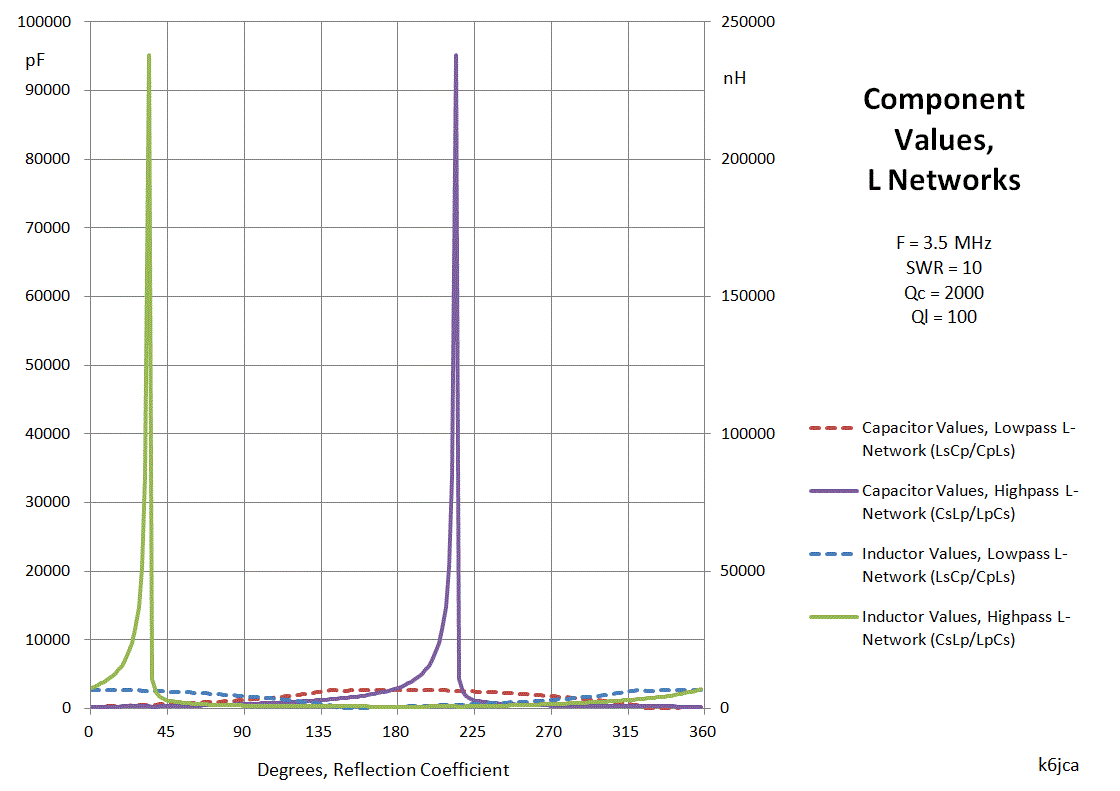
Component values for the highpass and lowpass configurations
Above you can see that the LsCp &CpLs configuration keeps the max component values quite flat. LsCp and CpLS are therefore the best engineering choices based on cost and realistic component values.
http://k6jca.blogspot.no/2015/04/notes-on-antenna-tuners-t-network-part-1.html